|
Multi-Point Inspection |
About & Services |
Diagnostics & Pricing |
Mobile & Terms |
Estimate & Appointment |
Payment |
Contact |
|
|
|||||||||
|
|||||||||

|

|

|

|

|
|
The False Economy of Customer-Supplied Parts and Low-Cost Installers
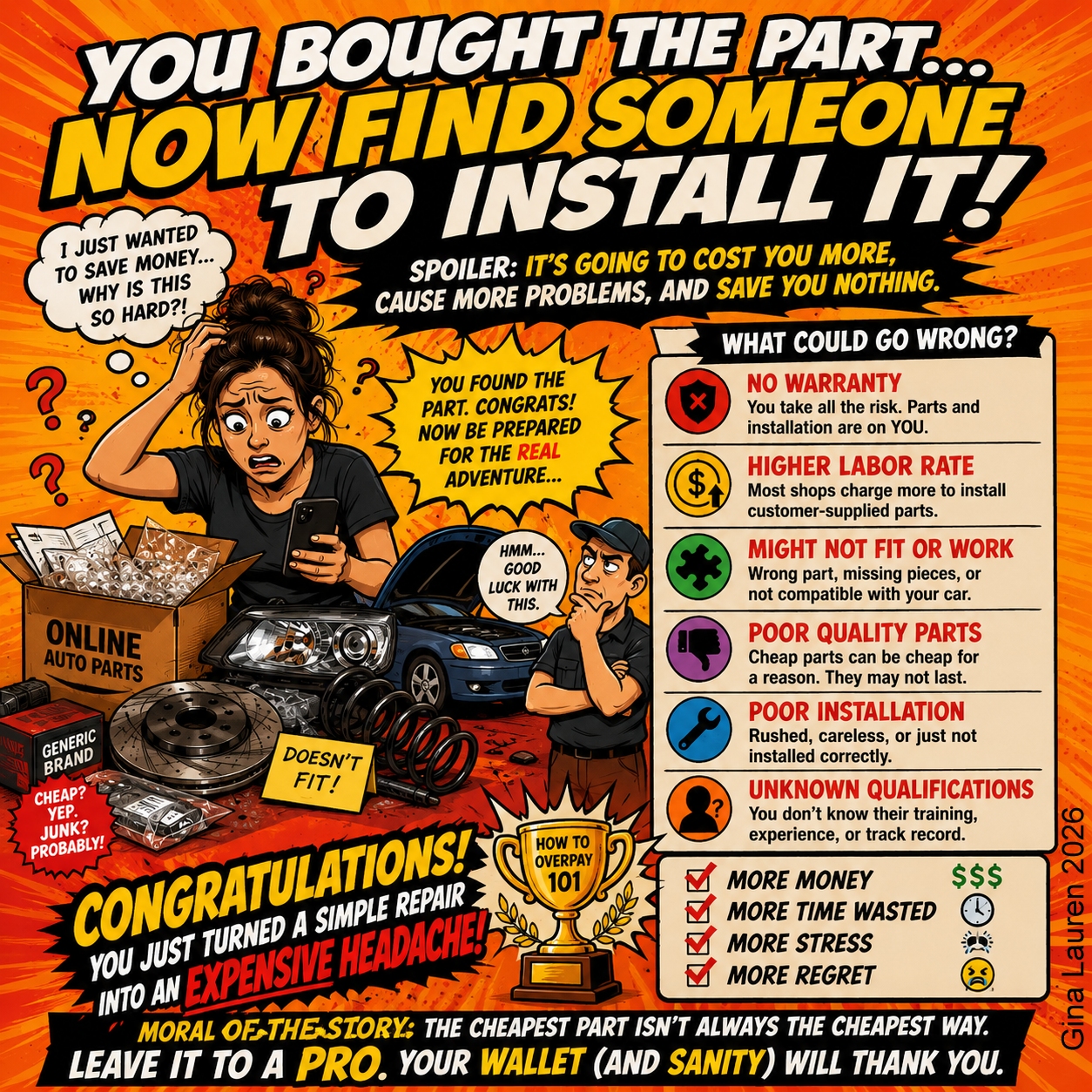 Over the past decade, a noticeable shift has occurred in the automotive repair industry. More vehicle owners are purchasing their own parts, relying on internet research instead of professional diagnosis, and seeking the lowest-cost person available to install those parts. In many cases, they are intentionally avoiding traditional repair businesses altogether. For repair facilities and professional technicians, this trend raises an important question: Is this simply a temporary response to economic conditions, or are we witnessing a fundamental change in how a segment of the public approaches vehicle repair? The answer is likely a combination of both. Several Trends Have ConvergedThis shift did not occur overnight. Instead, it is the result of multiple developments occurring simultaneously. Information is more accessible than ever before. Twenty years ago, most vehicle owners had little insight into how modern automotive systems worked. Today, a few minutes online can provide access to repair videos, technical discussions, troubleshooting guides, forums, and AI-powered tools that make many repairs appear straightforward. At the same time, obtaining vehicle fault codes has become commonplace. Many consumers receive a trouble code, search for information online, and conclude that a particular component must be defective. Whether that conclusion is correct is often another matter entirely. Parts availability has also changed dramatically. Vehicle owners can now compare prices from dozens of suppliers and have parts delivered directly to their homes, often at prices that seem difficult for repair businesses to match. Finally, finding someone willing to install those parts has become easier than ever. Individuals offering side-work services can advertise directly to large local audiences without the need for a physical location, significant overhead, or traditional business infrastructure. Together, these factors have created an alternative repair model that barely existed a generation ago. Economic Reality Cannot Be IgnoredWhile it is easy to criticize this trend, doing so often overlooks a significant factor: affordability. Modern vehicle repair has become expensive. Professional repair businesses face rising costs associated with labor, insurance, rent, diagnostic equipment, software subscriptions, training, utilities, regulatory compliance, and increasingly complex vehicles. These costs ultimately become part of the repair bill. At the same time, many consumers are facing financial pressures of their own. When presented with a repair estimate that exceeds their available budget, they often begin searching for alternatives. In many cases, vehicle owners are not choosing the cheapest option because they believe it is superior. They are choosing it because they believe it is the only option they can afford. Understanding this distinction is important. The Market Has Become SegmentedOne of the most interesting aspects of this trend is that it has effectively divided the automotive repair market into different customer groups. Some vehicle owners prioritize expertise, accountability, warranty coverage, proper diagnostics, and long-term reliability. These customers typically seek out established repair professionals and understand the value being provided. Others prioritize minimizing immediate cost above all else. They may supply their own parts, decline diagnostic procedures, and search exclusively for the lowest installation price available. These customers are often looking for:
From a business perspective, many experienced operators view this group not as direct competition, but as a separate market segment. The customer seeking the absolute lowest price was often unlikely to become a profitable customer for a professional repair operation in the first place. When Repair Becomes a CommodityThe larger concern is not necessarily lost business. It is the effect this trend has on perceived value. Increasingly, consumers compare fundamentally different services as though they are identical. For example, they may view these options as interchangeable:
The assumption is that if the same part gets installed, the service itself must be the same. In reality, the services are often very different. Professional operations invest heavily in training, diagnostic capabilities, insurance coverage, technical information, specialized equipment, warranty support, and accountability. Those investments are largely invisible to the customer until something goes wrong. When repair services become viewed solely as a labor charge attached to a part, the value of expertise becomes increasingly difficult to communicate. Why This Model Often Creates ProblemsWhile some repairs can be successfully completed using this approach, the model has significant limitations.
The distinction between installation and diagnosis becomes increasingly important as vehicle complexity increases. Is This Trend Growing?Most indications suggest that it is. The combination of readily available information, online parts suppliers, economic pressure, and easy access to low-cost installers has unquestionably increased the number of people attempting to manage repairs outside traditional channels. However, it is important not to overestimate its size. Public discussions about finding the cheapest installer tend to be highly visible, while customers who simply schedule an appointment with a professional repair business remain largely invisible. As a result, the trend can sometimes appear larger than it actually is. Its prevalence also varies significantly depending on vehicle age, vehicle value, geographic region, and the type of repair involved. Older vehicles and routine repairs are often affected most. Newer vehicles and complex diagnostic problems tend to remain firmly within the professional repair sector. The Bottom LineThe automotive repair industry is changing, and consumer behavior is changing with it. Technology has made information more accessible, online marketplaces have made parts easier to obtain, and economic pressures have encouraged many vehicle owners to seek lower-cost alternatives. Some repairs performed under this model will be successful. Others will ultimately cost more time and money than if the vehicle had been diagnosed and repaired correctly from the beginning. For professional repair businesses, the challenge is not simply competing on price. It is helping consumers understand that automotive repair is not merely the installation of parts. It is the process of accurately identifying problems, applying experience and technical knowledge, and delivering reliable solutions. Those services may appear similar on the surface, but they are not the same product. Consumers who rely on fault-code guessing, customer-supplied parts, and the lowest-cost installers are often taking on risks they may not fully appreciate.
These issues can quickly erase any initial savings. In many cases, vehicles eventually end up at a professional repair facility after multiple unsuccessful repair attempts, with additional problems created along the way. While this approach may occasionally save money, it frequently shifts the financial risk from the repair provider to the vehicle owner. When that gamble fails, the final cost is often much higher than if the vehicle had been diagnosed and repaired correctly from the start. Ultimately, the greatest risk to consumers is not necessarily the money spent on a particular repair, but the false confidence that comes from believing the problem has been properly addressed. A vehicle may appear repaired when, in reality, the underlying fault remains unresolved. This can lead to:
As modern vehicles become more dependent on complex electronics, software, network communications, and integrated control systems, the consequences of incorrect repairs can become increasingly significant. While cost will always be an important consideration, the lowest initial price is not always the lowest overall cost. What appears to be a bargain today can easily become a far more expensive repair tomorrow. More information is available here: Automotive Diagnostics & Pricing Guidelines
Speedy Pit Stop - Service AreaWe proudly serve the following ZIP codes in Palm Beach County:
Click to see a map.

|