|
Multi-Point Inspection |
About & Services |
Diagnostics & Pricing |
Mobile & Terms |
Estimate & Appointment |
Payment |
Contact |
|
|
|||||||||
|
|||||||||

|

|

|

|

|
|
Expectations vs Actual Repair Cost Structure
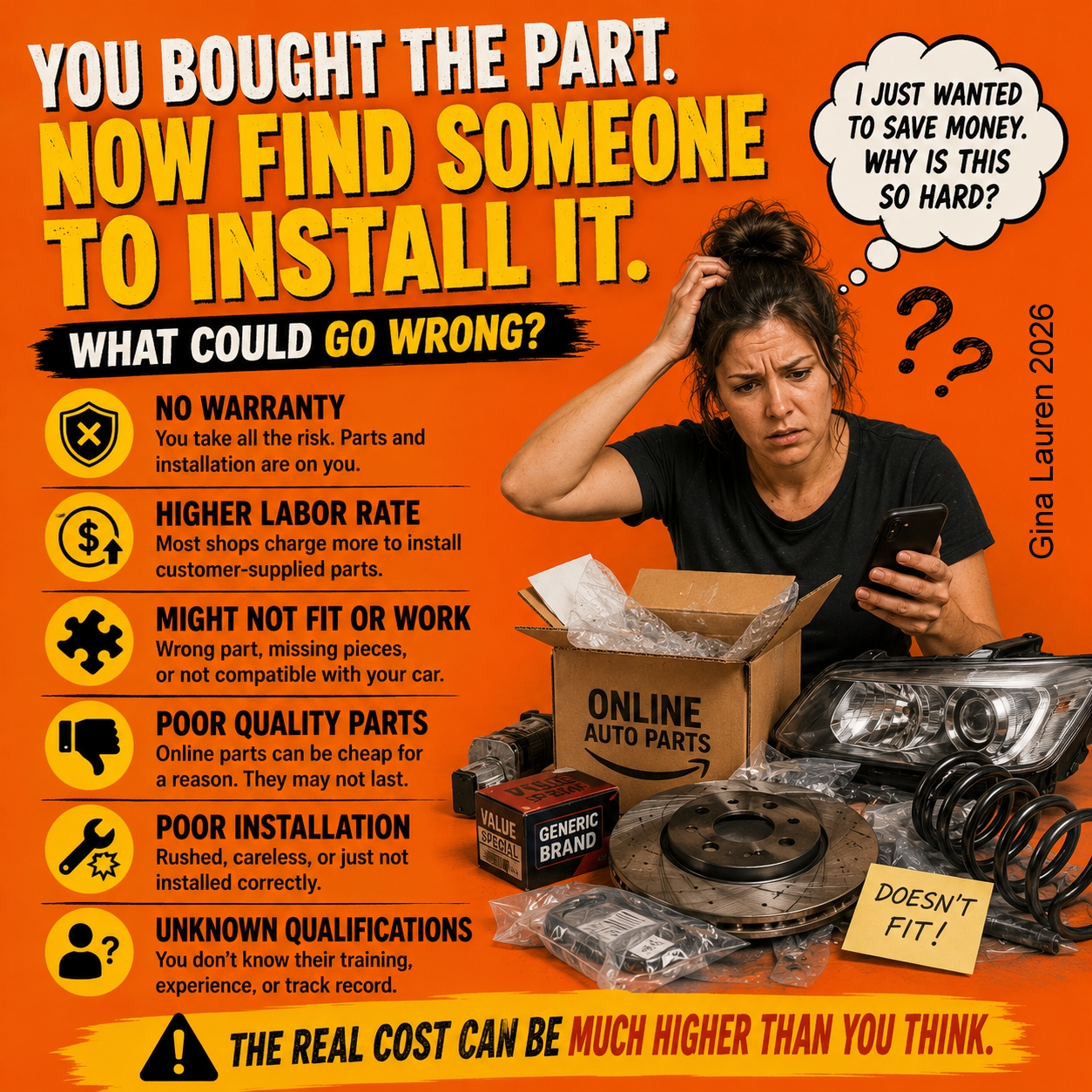 It is common to assume that purchasing your own automotive parts will reduce the total cost of a repair. On the surface, the logic appears straightforward, remove the markup on parts and the final bill should drop. In practice, the opposite often occurs. The overall pricing structure in automotive service is not built around isolated components, it is balanced across parts, service time, risk, and accountability.
Role of Parts Margin in Service PricingParts sales are not incidental, they are a core component of how service pricing is structured. The margin on parts offsets a portion of the operational cost required to perform accurate diagnostics, maintain equipment, manage risk, and stand behind the work. When that portion is removed, the pricing must shift elsewhere to remain viable. Typically, this results in a higher service rate or additional charges that bring the total cost back in line with what it would have been if the parts were supplied through the technician.
Customer-Supplied Parts and Warranty LimitationsThere are also practical constraints. Many technicians will not install customer-supplied parts at all. This is not arbitrary. Warranty obligations require control over the full repair process, including the sourcing of components. If a failure occurs, responsibility must be clear and traceable. When a part is supplied externally, that chain breaks. The technician assumes installation risk without control over the part's quality, origin, or correctness. For that reason, declining outside parts is often the only way to maintain consistent warranty coverage and manage liability exposure. Manufacturer parts warranties are also not straightforward in practice. Claims often require strict documentation, return authorization procedures, and proof of correct installation conditions. In many cases, the process is slow and can result in denial due to procedural or interpretation issues. Because of this, experienced repair providers frequently absorb or assume warranty responsibility directly, since they can control the outcome and avoid delays tied to third-party approval. Even when a manufacturer accepts a warranty claim, labor is typically excluded. This means the cost of removal, replacement, diagnostics, and reassembly is not reimbursed, leaving the service provider or customer responsible for labor expenses regardless of part coverage.
Liability Exposure in RepairsLiability exposure in this context is not theoretical. Consider a scenario where a customer supplies brake components that later fail, resulting in an accident. Even if the failure is traced back to a defective part, multiple parties can become involved in legal action. The vehicle owner may face claims, and the technician or business that performed the installation can also be drawn in under arguments related to workmanship or duty of care. Insurance companies routinely pursue recovery through subrogation, which can mean lawsuits against anyone connected to the repair. There have been documented cases in Florida where disputes over failed components escalated into litigation involving both the installer and the vehicle owner. Controlling the source of parts is one of the few ways a technician can limit this type of exposure.
Accuracy and Compatibility RisksAccuracy is another factor that is frequently underestimated. Modern vehicles have extensive variations, even within the same model year. Engine configurations, production changes, VIN splits, and software dependencies all affect part compatibility. A part that appears correct based on basic information can still be wrong. Professionals account for these variables through experience and verification processes. When the wrong part is introduced into the repair, the cost is no longer just the part itself, it includes lost time, repeated service, and delays. That typically exceeds any initial savings.
Quality Variability in Replacement PartsThere is also a quality dimension. Not all parts marketed under the same category meet the same standards. Differences in materials, tolerances, and manufacturing consistency can affect performance and longevity. A technician's sourcing decisions are influenced by failure rates, supplier reliability, and long-term outcomes, not just purchase price. When those controls are bypassed, the probability of premature failure increases, which again shifts cost back to the customer over time.
ConclusionThe central point is that the total cost of a repair is not determined by the price of a single component. It is the result of a system that balances parts, service, risk, and accountability. Removing one element does not eliminate cost, it redistributes it, often in less predictable ways. In many cases, supplying your own parts introduces additional variables that increase both immediate and long-term expense rather than reducing it.
Speedy Pit Stop - Service AreaWe proudly serve the following ZIP codes in Palm Beach County:
Click to see a map.

|